
Some Bitcoin-mining operators are reducing mining capacity while converting or developing sites for AI and high-performance computing. The interesting story is not cryptocurrency — it is that AI demand has made powered data-centre capacity valuable enough to compete with another extremely compute-intensive industry. For businesses, the lesson is that AI depends on expensive physical infrastructure, and AI strategy should be judged by the business value it creates.
Quick Answer
Some large Bitcoin-mining operators are reducing mining capacity while converting or developing sites for AI and high-performance computing.
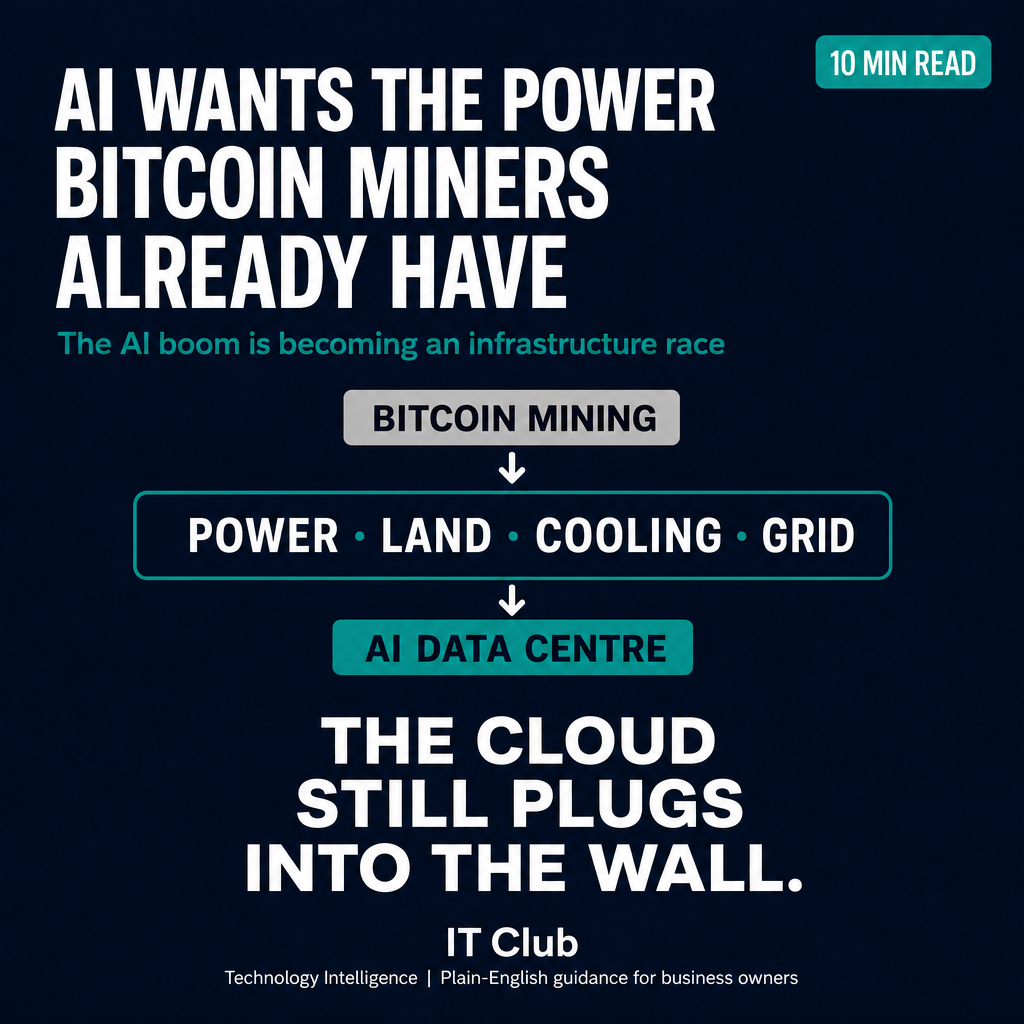
Why? Bitcoin miners already control something AI companies desperately need:
- Large electricity connections
- Suitable land
- Data-centre infrastructure
- Cooling systems
- Network connectivity
- Experience operating power-intensive computing around the clock
As AI infrastructure demand grows, some of those assets may generate more predictable or attractive returns supporting AI and HPC workloads than mining Bitcoin.
This does NOT mean Bitcoin mining is ending. It does NOT mean miners can simply replace ASIC miners with AI GPUs. It means AI infrastructure is now competing seriously for some of the same scarce physical resources.
AI may be digital, but the infrastructure race underneath it is very physical.
For years, Bitcoin miners were criticised for consuming enormous amounts of electricity to perform cryptocurrency calculations. The criticism became shorthand for a particular kind of computational excess — enormous power, visible heat, questionable purpose.
Now something interesting is happening. Some of those same operators have discovered another customer for their power connections, land, data centres, cooling infrastructure and network capacity.
That customer is artificial intelligence.
And in some cases, AI infrastructure is becoming more commercially attractive than Bitcoin mining.
The interesting story isn't that Bitcoin mining is shrinking. It's what AI companies are willing to compete with it for.
This is not primarily a cryptocurrency story. It is a story about how scarce physical infrastructure — land, power, cooling, grid connections — has become one of the most contested assets in the AI economy.
Why Bitcoin Miners Are Unusually Well Positioned
Bitcoin mining is not simply a software operation. It requires a specific combination of physical assets that are genuinely difficult and slow to obtain.
- Large, reliable electricity supply — often hundreds of megawatts
- Land with the right grid access
- Data-centre buildings or purpose-built structures
- Cooling — whether air, liquid or immersion
- Network connectivity
- Power distribution infrastructure including substations and transformers
- 24/7 operational capability
- Power purchase agreements and grid relationships
AI data centres require many of the same fundamentals. A site that was built and permitted for large-scale power consumption does not need to be reinvented to become attractive for AI infrastructure — though the technical upgrade required to host AI workloads can be substantial.
In the AI infrastructure boom, a large grid connection can be more strategically valuable than the computers plugged into it.
The valuable asset may increasingly be not the Bitcoin mining computers themselves — which are commodity hardware — but the power connection, the land, and the right to use the site. Those take years to acquire.
Bitcoin Mining and AI Are Not the Same Thing
Before going further: do not assume a Bitcoin mining facility can simply swap out ASIC miners for AI GPUs. The conversion may be possible in some cases, but it is not a straightforward hardware swap.
| Bitcoin Mining | AI / HPC | |
|---|---|---|
| Primary hardware | ASICs (Application-Specific Integrated Circuits) | GPUs and AI accelerators |
| Optimised for | SHA-256 hash calculations | Parallel floating-point computation |
| Networking | Relatively simple | Very high-speed interconnects required |
| Cooling | Air cooling often sufficient | May require liquid cooling; high rack densities |
| Storage | Modest | Substantial, high-speed storage often needed |
| Redundancy / uptime | Can tolerate some interruptions | Typically requires higher availability |
| Latency sensitivity | Lower | Higher for many AI workloads |
| Infrastructure complexity | Lower | Significantly higher |
A Bitcoin mine and an AI data centre may both consume enormous amounts of electricity, but technically they are very different facilities.
What a former mining site may offer is the land, the power connection and the shell of a data-centre building. Converting it for AI use can still require significant capital expenditure on networking, cooling upgrades, rack infrastructure and physical build-out.
The Real Asset: Grid Connections
AI companies can order GPUs. They can commission server builds. They can lease buildings. What they cannot quickly do is create hundreds of megawatts of grid capacity where none currently exists.
Connecting a large data centre to the electricity grid in the UK or North America can take years — involving planning, grid studies, equipment lead times, substation construction and regulatory processes. Existing mining operators may already have:
- Permitted and connected land
- Existing substations and transformers
- Transmission connections already approved
- Power purchase agreements already in place
- Operational experience and staff
- Relationships with local utilities and grid operators
AI's infrastructure bottleneck isn't only chips. It is getting enough electricity to the chips.
How Much Electricity Does AI Actually Need?
The International Energy Agency estimated that global data centres consumed around 415 TWh of electricity in 2024 — approximately 1.5% of global electricity consumption. Its base case projects this could roughly double to around 945 TWh by 2030, approaching 3% of global electricity demand. The IEA identifies AI as the most important driver of this increase, alongside continued growth in other digital services. Verify all IEA figures against current published reports before relying on them.
Global data-centre electricity demand (IEA estimates — verify)
- 2024 — approximately 415 TWh (~1.5% of global electricity)
- 2030 — approximately 945 TWh (~3% of global electricity, IEA base case)
- AI identified as the largest driver of the increase
Data centres remain a relatively modest share of total electricity demand globally — but AI is driving rapid growth.
It is important not to overstate this. Data centres are not the only major electricity consumer, and AI does not consume all data-centre electricity. The picture is one of rapid growth from a modest base — significant at a local level even if modest at a global one.
The Local Grid Problem
The global share of electricity consumed by data centres may appear manageable. But data centres do not spread their demand evenly. They concentrate enormous power requirements in specific locations — and that is where the constraint becomes acute.
The IEA has noted that this concentration can make integration into local electricity grids challenging. Its research suggested that around 20% of planned data-centre projects could face delays if grid constraints are not addressed. Verify the current wording and figure from IEA published materials before publication.
The problem isn't simply how much electricity AI uses globally. It's how much electricity a data centre wants in one place.
Why Miners May Redirect Infrastructure
Bitcoin-mining economics are determined by several variables simultaneously: the Bitcoin price, the block reward, network difficulty, electricity cost, hardware efficiency and financing. When these variables shift, the business case for mining changes.
In April 2024, the Bitcoin network underwent its latest halving — a programmed reduction of the block reward from 6.25 BTC to 3.125 BTC per block. Verify this figure. Halvings reduce the revenue earned from mining for a given amount of computing power, making the economics more sensitive to electricity costs, hardware efficiency and Bitcoin's market price.
Meanwhile, AI infrastructure demand has increased substantially. Some miners therefore face a genuine commercial question: should scarce electricity and data-centre capacity be used for Bitcoin mining, or leased or contracted to AI and HPC customers?
The potential advantages of AI/HPC contracts may include contracted long-term revenue, hyperscaler or enterprise customers, more predictable cash flows and infrastructure diversification. This does not mean AI is universally more profitable than mining — that depends on factors including Bitcoin's price trajectory, AI contract terms, capital expenditure required for conversion and operating economics. Use appropriate caution when making these comparisons.
The Shift Is Already Visible
Reporting by Cointelegraph in August 2026, citing data from a cohort of publicly traded Bitcoin miners, indicated that realised hashrate among that group fell from approximately 368.3 EH/s in Q4 2025 to approximately 319 EH/s in Q2 2026 — a decline of around 13.4%. Excluding Bitdeer, which reportedly expanded mining capacity substantially during this period, the decline within the cohort was approximately 21.2%. These figures apply specifically to that cohort of public miners and should not be read as representing the entire Bitcoin-mining industry. Verify against primary company disclosures.
Some operators within that group increasingly report revenue from HPC hosting, colocation and data-centre services alongside — or instead of — mining revenue.
Cointelegraph cites, and primary company reporting has indicated, figures including Core Scientific reporting approximately $136.7 million in Q2 colocation revenue compared with approximately $27.5 million in Bitcoin mining revenue. TeraWulf reportedly recorded approximately $31.9 million in HPC lease revenue compared with approximately $12.8 million in mining revenue. These figures should be verified against each company's primary investor disclosures before publication — the brief notes they come from Cointelegraph's reporting rather than being independently confirmed.
These figures cover a specific cohort of publicly traded miners and do not represent the Bitcoin-mining industry as a whole. Some operators — including Bitdeer — continued to expand mining capacity during the same period.
A Current Example: Riot Platforms and AI Compute
Reporting in August 2026 suggests Riot Platforms has announced a significant long-term agreement involving AI compute and data-centre services at its Rockdale, Texas facility, reportedly involving Anthropic as a customer and possibly AMD hardware. Full details of the contract — including duration, capital expenditure obligations, expansion options, conditional elements and precise megawatt allocation — should be verified against Riot's primary investor announcements and press releases before publication. IT Club has not independently confirmed all aspects of this arrangement.
Subject to verification, it would represent an example of how significant the infrastructure shift has become: a major Bitcoin-mining company committing large physical infrastructure to AI compute for an AI model developer of Anthropic's scale.
Use only confirmed details when this article goes live. Do not repeat headline contract values without explaining duration, conditional elements and capital commitments.
This Is Not the End of Bitcoin Mining
It is easy to read the headlines and conclude that Bitcoin mining is in terminal decline. That is not supported by the evidence.
Bitcoin's network continues operating. Some miners are expanding. Bitdeer, for example, reportedly increased its realised hashrate during the same period that other publicly traded miners reduced theirs. New mining sites continue to be developed. Hardware manufacturers continue to release next-generation ASICs.
The story is competition for infrastructure, not the death of Bitcoin.
What is happening is a reallocation trend among some operators — particularly those who control large amounts of data-centre and electrical infrastructure and can weigh the commercial case for AI contracts against continued mining. It is not a universal withdrawal from mining.
Can the Same Electricity Be Used Twice?
No. If a site has 100 MW of available electrical capacity and reallocates part of it from Bitcoin mining to AI and HPC, that capacity is no longer available for mining at the same time.
However, the decisions are more complex than simply moving a switch. Facilities may expand by developing additional substations or data halls. They may run mining and HPC operations in separate parts of the same campus. They may phase conversion over years. They may continue mining on older hardware while building new HPC capacity alongside it.
The infrastructure does not have to be an either/or choice in all cases — but where capacity is finite and power is constrained, decisions about how to allocate it have genuine commercial and operational consequences.
What Happens to Bitcoin Hashrate?
Bitcoin hashrate measures the total computing power participating in the mining network. If some miners remove mining capacity, network hashrate can decline — at least temporarily.
Bitcoin's protocol automatically adjusts mining difficulty periodically to account for changes in total computing power. The network can continue operating with different amounts of computing capacity — it adjusts to match what is available. This is a design feature rather than a vulnerability.
Bitcoin's protocol can adjust to changing mining capacity. The business story is why operators are reallocating the infrastructure.
This article does not speculate about Bitcoin's price or the security implications of hashrate changes. Those are separate discussions outside IT Club's editorial remit.
The Bigger AI Infrastructure Race
Step back from Bitcoin entirely. The real story is about what AI companies are competing for.
What AI infrastructure requires
- Power — hundreds of megawatts per large facility
- Land — with grid access and planning permission
- Grid connections — which can take years to obtain
- Transformers — which face significant supply constraints
- Cooling — increasingly liquid cooling for high-density GPU clusters
- Chips — GPUs and accelerators in limited supply
- High-speed networking — within and between facilities
- Data-centre capacity — built and fitted
Every one of these inputs is physically constrained. AI is becoming an infrastructure race.
The AI race is increasingly becoming an infrastructure race.
This affects not just AI companies and data-centre operators, but utilities, grid operators, governments, construction companies, equipment manufacturers and local communities. The AI boom has second-order effects well beyond the software industry.
IT Club looked at the community and planning dimension of this in an earlier article:
America Loves AI — So Why Does It Hate the Data Centres That Power It? →
That article examined the tension between AI demand and local opposition to the data centres that serve it. This one adds another dimension: AI operators increasingly competing with other power-intensive industries for existing infrastructure.
Why Should a Normal Business Care?
A typical SME does not need to understand Bitcoin hashrate. But the infrastructure shift matters because it tells us something important about AI economics.
AI is not free computing in the cloud. AI services depend on expensive chips, purpose-built data centres, substantial electricity, cooling systems, high-speed networks and enormous capital expenditure. These costs eventually influence AI service pricing, cloud pricing, regional availability, sustainability decisions and product economics.
Every cheap AI subscription sits on top of very expensive infrastructure.
The £20 AI Subscription Illusion
A user may pay £20–£30 per month for an AI service. That can make AI feel cheap — almost trivially so. But behind the interface may sit GPU clusters, high-speed networking, large-scale storage, purpose-built cooling systems, data-centre buildings, electrical grid infrastructure and billions in capital expenditure.
What sits beneath an AI service
- AI application (the interface you see)
- AI model (the intelligence behind the response)
- Compute — GPU / accelerator clusters
- High-speed networking — within and between facilities
- Storage — large-scale and high-speed
- Cooling — increasingly liquid
- Data-centre building — purpose-built or adapted
- Electricity — at enormous scale
- Grid infrastructure — substations and transmission
- Billions in capital expenditure
THE CLOUD STILL PLUGS INTO THE WALL.
Consumer and business subscription prices do not directly reveal the underlying cost of building AI infrastructure. AI service providers have been investing heavily and absorbing costs during a period of rapid scaling. That is not guaranteed to continue indefinitely.
The price of an AI licence and the cost of building the AI economy are two very different numbers.
What This Could Mean for AI Pricing
Be cautious about predictions in either direction. AI costs may fall significantly because of better chips, more efficient model architectures, stronger competition between providers, operational scale and software optimisation. That is a plausible trajectory and is already happening with some models.
But infrastructure costs — electricity, data centres, networking, GPU hardware, cooling and financing — are real and substantial. Businesses should not build their AI strategy on an assumption that today's pricing will remain unchanged.
Build the business case around value created, not around an assumption that AI compute will always be cheap.
Sustainability
AI infrastructure has genuine environmental impacts: electricity demand, water use for cooling, construction, equipment manufacturing and grid expansion. These are real costs that deserve honest assessment.
The IEA expects a mixture of renewables, natural gas and nuclear capacity to meet the additional data-centre demand it projects. The actual energy mix depends heavily on where data centres are located, what power purchase agreements they hold and what each country's grid looks like. It is not accurate to claim that AI runs entirely on fossil fuels, nor that it runs entirely on renewables.
There is no single answer to 'what powers AI?' It depends heavily on where the data centre is located and how its electricity is sourced.
Could AI Actually Help the Grid?
Bitcoin mining has historically demonstrated unusually flexible electricity consumption. Mining workloads can sometimes be curtailed rapidly when grid demand is high, effectively helping balance supply and demand. Some miners have operated as demand-response participants with grid operators.
AI workloads may have different operational constraints. Training runs, for example, may be difficult to interrupt without losing significant work. Inference workloads may be more flexible depending on latency requirements. The flexibility profile of AI data centres is not the same as Bitcoin mining.
There is genuine interest in intelligent scheduling of AI workloads, geographic workload shifting, on-site generation and battery storage to help AI infrastructure work with the grid rather than simply placing demands on it. This remains an active area of development rather than a solved problem.
One of the challenges will be making enormous computing loads work with the grid rather than simply demanding the grid work around them.
The AI Infrastructure Stack
- AI application — what users interact with
- AI model — the trained intelligence
- Compute — GPU clusters and AI accelerators
- Server — hardware hosting the compute
- Network — high-speed interconnects
- Data centre — building and physical infrastructure
- Cooling — air, liquid or immersion
- Electricity — at enormous scale
- Grid — substations, transformers, transmission
THE CLOUD STILL PLUGS INTO THE WALL.
Five Business Lessons from the AI Infrastructure Story
1. AI is physical
The user experience feels digital. The infrastructure underneath is buildings, cables, transformers, chips, cooling systems and electricity. Understanding this reframes how businesses should think about AI costs, availability and long-term strategy.
2. Compute is not infinite
Businesses should expect changing model pricing, usage limits, different performance tiers, regional availability variation and evolving cloud economics. Plan accordingly rather than assuming today's pricing and availability are permanent.
3. Efficiency will matter
Organisations should not simply use the largest, most expensive model for every task. A smaller, faster model is often sufficient for classification, summarisation and routine generation. Reserve frontier models for tasks that genuinely need their capability.
Good AI strategy is not about consuming the most compute. It is about buying enough intelligence for the task.
4. AI ROI matters
As AI becomes infrastructure-intensive and providers eventually price accordingly, organisations need to ask what business outcome each AI tool is actually producing. Measure time saved, revenue generated, cost reduced, errors prevented or customer experience improved — not just usage volume.
AI consumption without a business outcome is just another cloud bill.
5. The AI boom has second-order effects
AI demand is already influencing power generation, grid infrastructure, construction, cooling, semiconductor manufacturing, nuclear energy investment, property values near data-centre sites and water resources. The most interesting AI stories increasingly happen outside the AI software industry.
The most interesting AI stories increasingly happen outside the AI software industry.
What Businesses Should Do
- 1. Measure AI usage — know which tools and models are being consumed and at what cost
- 2. Measure business value — tie usage to outcomes: time saved, revenue, cost reduction, quality improvement
- 3. Avoid model overkill — do not use expensive frontier models for tasks that a simpler model handles adequately
- 4. Watch pricing — AI pricing will evolve as infrastructure costs are distributed more directly
- 5. Watch cloud commitments — avoid unnecessary lock-in to a single AI provider
- 6. Include AI in technology budgeting — pilot pricing rarely equals mature operating cost
- 7. Review regularly — capabilities and economics are changing rapidly enough that quarterly review is worthwhile
The IT Club View
The interesting thing about Bitcoin miners redirecting infrastructure towards AI is not Bitcoin.
It is the price the technology industry is effectively placing on powered data-centre capacity. AI demand has become significant enough that infrastructure originally built for another extremely compute-intensive industry is being reconsidered for AI deployment.
That tells businesses something important. AI is becoming infrastructure. It needs power, hardware, buildings, networks and capital — just like other infrastructure industries. The question for normal businesses is therefore not 'should we buy a Bitcoin mine?'
It is: are we using expensive AI infrastructure to create enough business value to justify consuming it?
AI feels like software. Increasingly, its economics look like infrastructure.
The shift from Bitcoin mining towards AI data centres is another sign that the AI boom is moving beyond software. The next phase will be shaped as much by electricity, grid connections, cooling and physical capacity as by the models themselves.
Operational Heartbeat
For businesses using AI operationally, periodically review AI tools and licences, usage volumes, API and model spend, model selection, business outcomes achieved, cost per task, duplicated subscriptions, data and privacy exposure, supplier dependency and pricing changes.
AI needs an Operational Heartbeat: usage, cost, model choice, supplier dependency and business value should be reviewed rather than assuming today's AI economics will remain unchanged.
Plain-English Takeaway
Some Bitcoin miners are reducing mining capacity while developing or leasing infrastructure for AI and high-performance computing. The reason is not that Bitcoin mining has suddenly disappeared, but that AI companies increasingly need the same scarce assets miners already control: power, land, grid connections and data-centre infrastructure. For ordinary businesses, the lesson is that AI is not an unlimited digital resource. Behind every AI service sits expensive physical infrastructure, and businesses should build their AI strategy around measurable value rather than assuming compute will always be abundant and cheap.
Related Questions
Why are Bitcoin miners moving into AI?
Some Bitcoin miners already control large electricity connections, data-centre infrastructure, land and cooling systems — the same scarce physical assets AI companies need. In some cases, the commercial returns from leasing or converting that infrastructure for AI and HPC use may be more attractive or predictable than continuing to mine Bitcoin.
Are Bitcoin miners becoming AI data centres?
Some are converting or developing sites for AI and HPC use. Others continue expanding mining capacity. It is a reallocation trend among some operators, not a universal industry shift.
Can Bitcoin mining hardware run AI?
Not directly. Bitcoin miners use ASICs — chips optimised for a specific SHA-256 calculation. AI training and inference run on GPUs and AI accelerators. The hardware is fundamentally different.
Can Bitcoin ASICs run AI models?
No. ASICs are purpose-built for Bitcoin's proof-of-work algorithm. They are not general-purpose processors and cannot run AI model workloads. Converting a mining facility to AI use requires new GPU or accelerator hardware.
Are AI GPUs the same as Bitcoin miners?
No. They are different hardware for different purposes. Bitcoin mining uses ASICs. AI uses GPUs and specialised accelerators. The facilities may share some physical infrastructure requirements — power, cooling, land — but the computing hardware is completely different.
Why do AI data centres need so much electricity?
AI model training requires enormous amounts of parallel computation across thousands of chips simultaneously. Inference — running queries against a trained model — also requires significant compute at scale. Each chip consumes power, generates heat that must be removed, and requires networking and storage that also consume power.
How much electricity do data centres use?
The IEA estimated approximately 415 TWh globally in 2024 — about 1.5% of global electricity consumption. Verify against current IEA publications.
How much electricity will data centres use by 2030?
The IEA's base case projects approximately 945 TWh by 2030 — roughly double 2024 levels and approaching 3% of global electricity consumption. AI is identified as the largest driver of the increase. Verify against current IEA publications.
Does AI use more electricity than Bitcoin?
On a total global basis, data-centre electricity consumption (of which AI is a growing but not exclusive part) substantially exceeds published Bitcoin-mining electricity estimates. However, making precise comparisons is difficult due to measurement methodology differences. Both are significant and both are growing.
Are Bitcoin miners shutting down?
No, not as an industry trend. Some publicly traded operators are redirecting capacity towards AI and HPC. Others are expanding mining. Bitdeer, for example, reportedly expanded mining capacity during the same period when others in the cohort reduced theirs.
Is Bitcoin hashrate falling?
Cointelegraph reported a 13.4% decline in realised hashrate among a specific cohort of publicly traded Bitcoin miners between Q4 2025 and Q2 2026. This applies to that cohort and should not be read as representing the entire network's hashrate trajectory. Verify against primary sources.
What happens if Bitcoin miners stop mining?
Bitcoin's protocol adjusts mining difficulty automatically. If less computing power participates, difficulty decreases and the remaining miners can still produce blocks. The network is designed to continue operating across a wide range of mining participation levels.
What is HPC?
High-Performance Computing — computing work that requires very large amounts of processing power, typically using clusters of specialised hardware. AI training is a prominent example. Scientific simulation, weather forecasting and financial modelling are others.
Why are grid connections valuable?
Obtaining permission and physical capacity to connect a large data centre to the electricity grid can take years — involving planning processes, grid capacity studies, equipment lead times and substation construction. A site that already has a permitted, large-capacity grid connection has cleared one of the most significant barriers to data-centre development.
Can old Bitcoin mines become AI data centres?
Some can be converted or developed for AI use, but it is not a simple swap. AI and HPC workloads typically require more complex networking, different cooling infrastructure, higher physical density and greater redundancy than Bitcoin mining. Conversion requires capital expenditure and technical build-out.
What infrastructure does an AI data centre need?
Large and reliable electricity supply, land with grid access, purpose-built or adapted buildings, high-density cooling (increasingly liquid), high-speed networking within and between facilities, large-scale storage, physical security and 24/7 operational support.
Will AI electricity demand increase?
The IEA projects significant growth in data-centre electricity consumption driven primarily by AI through 2030. Whether this increase is partially offset by more efficient AI architectures remains to be seen. Verify IEA projections against current published figures.
Will AI become more expensive?
AI costs may fall due to better chips, more efficient models, competition and scale. They may also be influenced by infrastructure costs — electricity, data centres and hardware. IT Club does not predict future AI pricing. Businesses should plan for pricing evolution rather than assuming today's prices are permanent.
Why should SMEs care about AI infrastructure?
Because the economics of AI infrastructure eventually influence AI service pricing, availability, regional access and cloud costs. Understanding that AI depends on scarce and expensive physical resources helps businesses make more honest assessments of AI ROI and long-term costs.
How should businesses budget for AI?
Include AI licensing, API usage and model costs in the technology budget. Measure actual consumption against actual business outcomes. Do not assume pilot pricing equals long-term operating cost. Review regularly as pricing and capabilities evolve.
What does AI ROI mean?
The return on investment from AI tools — measured in time saved, cost reduced, revenue generated, errors prevented or customer experience improved. AI ROI is not measured in features used or models subscribed to.
Should businesses use smaller AI models?
For many routine tasks, yes. Smaller and faster models are often sufficient for classification, summarisation, extraction and basic generation — and cost less to run. Frontier models should be used where their additional capability is genuinely needed.
Is AI sustainable?
AI data centres have real environmental impacts — electricity consumption, water use for cooling and equipment manufacturing. The sustainability profile depends heavily on the energy mix of the grid where data centres operate. There is no single answer, and the picture is evolving as providers make renewable energy commitments and grids decarbonise.
What is the AI infrastructure stack?
The full chain of physical infrastructure underneath an AI service: AI application → AI model → compute (GPUs/accelerators) → server → network → data centre → cooling → electricity → grid. The user sees the application. The infrastructure underneath it is physical, capital-intensive and resource-constrained.
Are your AI costs actually creating business value?
Tell the IT Club Advisor what AI tools your business is using, what you are paying for them and what you are trying to achieve. We can help you challenge whether the technology matches the task.
Ask Your IT Question — Free to ask. No credit card. No sales pressure. →
Related Reading
America Loves AI — So Why Does It Hate the Data Centres That Power It? →
Why Is AI Computing Power Becoming a Tradable Commodity? →
Is AI Saving Your Staff Time — or Creating More Admin? →
Cheaper AI Is Catching Up — What Business Owners Should Know →
Plain-English Takeaway
Some Bitcoin miners are reducing mining capacity while developing or leasing infrastructure for AI and high-performance computing. The reason is not that Bitcoin mining has suddenly disappeared, but that AI companies increasingly need the same scarce assets miners already control: power, land, grid connections and data-centre infrastructure. For ordinary businesses, the lesson is that AI is not an unlimited digital resource. Behind every AI service sits expensive physical infrastructure, and businesses should build their AI strategy around measurable value rather than assuming compute will always be abundant and cheap.
Tap to follow The IT Club Briefing on WhatsApp.
Related Articles
Are You an AI Zoomer, Bloomer, Gloomer or Doomer?
Four broad attitudes towards AI are useful in a business meeting: move faster, test it properly, show me the risks, or question whether we should use it at all. Here is how an SME can use all four viewpoints.
Read articleThe EU AI Act Is Now Being Enforced — Does Your Business Know What AI It Is Using?
The EU AI Act is now broadly applicable, but that does not mean every UK SME needs an EU compliance project. The practical starting point is knowing what AI your business uses, what data goes into it and who governs it.
Read articleIs Your Website Actually Backed Up? Why a Cloud Website Still Needs a Recovery Plan
A website being hosted in the cloud does not automatically mean your business has an independent backup or a tested recovery plan. Learn what a useful website backup should protect, how GitHub can help, and what recovery questions to answer.
Read article