When Does a Business Need a Fractional Project Manager?

Fractional project management gives businesses temporary access to experienced project leadership when important technology projects need more structure than internal teams can provide. The model suits occasional complex projects where several suppliers, overloaded managers and unclear ownership create delivery risk. Success still requires an executive sponsor, clear authority, realistic scope and internal decision-making.
The business has decided to act. Perhaps it is moving to Microsoft 365, implementing a new CRM, running a Cyber Essentials programme, relocating the office, replacing ageing servers, introducing a new finance system, or changing IT provider. The project is real, the deadline exists, and the stakes are significant.
At the start, responsibility is spread across the managing director, internal IT, the finance team, operations, an external IT provider, software suppliers, and consultants. Everyone is involved. Meetings happen. Emails circulate.
Nobody is actually managing the whole project.
Suppliers begin working to different assumptions. Deadlines shift. Nobody owns the dependencies between workstreams. Decisions remain unresolved for weeks. Costs appear that were not in the original budget. Users hear about changes the day before they happen. Testing gets compressed because the go-live date is fixed. Risks stay undocumented. Technical teams blame each other. Senior management assumes somebody else has it under control.
The warning sign is not that the project has no project plan. It is that nobody can clearly say who owns delivery.
This situation is common in small and medium-sized businesses, not because the businesses are badly run, but because they rarely carry a permanent project-management capability. Projects arrive occasionally and then stop. Managers have operational responsibilities that cannot pause. And the expertise needed to coordinate suppliers, manage scope and maintain decision discipline is genuinely specialist.
A project does not need a full-time project manager to need proper project management.
What is a fractional project manager?
A fractional project manager is an experienced project professional engaged for part of their time, a defined phase or a specific project rather than as a permanent full-time employee.
They may help with:
- Project discovery and scope definition
- Timelines, milestones and resource planning
- Defining responsibilities across internal teams and suppliers
- Supplier coordination and independent challenge
- Risk, issue and decision management
- Meetings, status reporting and communications
- Testing planning and cutover management
- Project recovery
- Project closure
Fractional support can make sense where:
- The project is important but temporary
- Internal managers lack capacity alongside operational responsibilities
- Several suppliers are involved and nobody is independently coordinating them
- Delivery has become unclear or is already slipping
- Specialist project experience is needed for this type of change
- The organisation cannot justify a permanent project-management role
It may not make sense where:
- There is no executive sponsor willing to own the business outcome
- Nobody in the business will make the decisions the project requires
- The scope is fundamentally unclear and the business has not agreed it
- The budget is unrealistic for the work described
- Internal resources needed for testing, training or adoption do not exist
- The project manager would carry responsibility without genuine authority
A project manager can create structure. They cannot compensate indefinitely for missing leadership, money or decisions.
Understanding the terms
The terminology around external project management overlaps and suppliers use these labels differently. What matters is not the title but the scope, authority, time commitment and responsibility written into the engagement.
| Term | Typical meaning |
|---|---|
| Fractional project manager | A project manager engaged for an agreed proportion of their time rather than as a permanent full-time employee |
| Interim project manager | Usually someone temporarily filling a project-management role during a defined period, often covering a gap or transition |
| Contract project manager | A project manager working under a fixed-term contract for a defined project or period |
| Outsourced project manager | Project-management responsibility delivered by an external provider |
| Project management consultant | May advise on project structure, governance or delivery without necessarily owning day-to-day management |
| Virtual PMO | An external project-management capability providing broader structure, governance, reporting or several project-management resources |
The label matters less than the scope, authority, time commitment and responsibility written into the engagement.
Why small and medium-sized businesses use fractional project management
Most SMEs do not run projects continuously. A business might have one or two significant technology changes each year — a migration, a new system, a compliance programme, an office move — and then a quiet period. Carrying a permanent full-time project manager for occasional use is difficult to justify.
At the same time, those occasional projects can be operationally significant. A failed Microsoft 365 migration disrupts every member of staff. A poorly executed CRM rollout produces a system nobody uses. A Cyber Essentials programme that loses momentum misses its certification deadline. The consequences of poor project delivery are real.
Five practical reasons SMEs use fractional project management:
- No permanent requirement — the business runs a few major projects each year, not a continuous pipeline
- Internal capacity — operational managers already have day jobs that cannot pause for a six-month project
- Specialist experience — some projects require someone familiar with cloud migrations, software implementations, cyber-security programmes or supplier transitions specifically
- Project recovery — an experienced project manager can re-establish scope, ownership, priorities and timeline when delivery has already become unclear
- Independence — an external project manager can challenge supplier assumptions, unrealistic deadlines, poorly defined scope and internal politics without the conflicts of interest that internal advocates sometimes carry
Fractional support works best when the need is significant but not permanent.
The real problem with technology project delivery
Many failed SME technology projects do not fail because of technical problems. They fail because of coordination failures.
The problems that accumulate tend to follow a pattern: nobody clearly owns the project, success criteria were never defined, scope was agreed informally and then changed informally, several suppliers are involved but nobody is independently watching the dependencies between them, decisions required from the business sit unresolved for weeks, deadlines were set optimistically without examining what the work actually requires, users are told too late, testing is squeezed, and nobody agrees what project completion looks like.
A technically capable supplier can still deliver its part successfully while the overall project fails.
A CRM supplier might deliver a fully configured system. An IT provider might complete a migration of every mailbox. A connectivity supplier might install the new office circuits. But if the dependencies between these workstreams were not coordinated, the data was not prepared, users were not trained, testing was not planned and nobody owns what happens when something breaks, the project has not delivered its business outcome.
What a fractional project manager should actually do
Project management is not organising meetings. It is making ownership, dependencies, risks and decisions visible.
The work across a typical technology project covers several distinct areas:
- Discovery — understand the business objective, current environment, stakeholders, suppliers, dependencies, risks, deadlines and constraints before planning begins
- Scope — define what is included and excluded, document assumptions, agree acceptance criteria and establish how scope changes will be controlled
- Planning — create milestones, map dependencies, identify resource requirements, define decision points, plan testing stages, prepare a cutover plan and consider rollback
- Ownership — define the executive sponsor, project manager, technical owner, business owner, supplier responsibilities, user responsibilities and decision authority so everyone knows who does what and who decides what
- Risk management — maintain a risk register, issue log, decision log, dependency register and action tracker; make risks visible rather than assuming they will resolve themselves
- Supplier coordination — coordinate internal IT, the managed services provider, telecoms supplier, software supplier, cyber-security provider, Microsoft partner, consultants, facilities and finance as a single programme rather than separate conversations
- Communication — provide regular status, document actions and decisions, surface risks, communicate upcoming changes and prepare users before they are affected
- Delivery — manage milestones, oversee testing, control change requests, support user readiness and manage the cutover
- Closure — confirm acceptance criteria, resolve outstanding issues, transfer documentation, confirm support ownership, remove temporary access and conduct a benefits review
Fractional versus full-time project manager
Neither model is universally better. The right choice follows the workload.
| Fractional project manager | Full-time project manager | |
|---|---|---|
| Potentially suited to | Occasional major projects, temporary capacity gaps, specialist change types, project recovery, SMEs, short programmes | Continuous project pipelines, larger organisations, complex internal programmes, ongoing transformation, permanent PMO |
| Potential advantages | Flexible commitment, specialist experience, quicker access to expertise, independent challenge, no long-term employment commitment | Deep organisational knowledge, continuous availability, long-term relationships, permanent capability |
| Potential disadvantages | Limited availability, time required to learn context, dependence on internal stakeholders, possible supplier conflicts, knowledge can leave after the engagement | Permanent employment cost, recruitment time, potentially underused between major projects, one individual may not cover every specialist area |
The choice should follow the workload — not the fashionable job title.
When a fractional project manager will not fix the problem
It is worth being direct about the situations where bringing in external project management will not resolve the underlying difficulty.
A fractional project manager is unlikely to rescue a project where:
- The business case is weak or the project was approved without examining whether it is achievable
- The budget is unrealistic for the scope described
- Senior management will not make the decisions the project requires
- There is no executive sponsor who owns the business outcome
- Suppliers are contractually misaligned and disputes are unresolved
- The internal resources needed for testing, training or adoption do not exist
- Key staff refuse to participate or are actively resistant
- Requirements change every week and the business cannot agree what it actually wants
- Nobody agrees what success means
- The delivery timeline is politically fixed but technically impossible
- The project manager cannot challenge assumptions or escalate concerns
- The project manager has responsibility without genuine authority
Do not hire a project manager to absorb accountability senior management is unwilling to own.
Authority and governance
A project manager's effectiveness depends significantly on the governance structure around them. Four roles are relevant to most significant technology projects:
| Role | Owns |
|---|---|
| Executive sponsor | The business outcome. Makes significant business decisions, resolves escalated blockers and owns the project's relationship with organisational priorities. |
| Project manager | Coordination and controlled delivery. Makes delivery visible, escalates risks and decisions, manages scope and keeps stakeholders aligned. |
| Technical lead | Technical design and implementation quality. Owns technical decisions within the agreed scope. |
| Business owner | Operational requirements, user acceptance and adoption. Represents the people who will use the outcome. |
A project manager should have authority to call meetings and obtain attendance, challenge missed actions, escalate risks and request decisions, control the agreed change process, obtain status from suppliers and coordinate across workstreams.
A project manager should not silently make executive business decisions, legal decisions, financial approvals, security-risk acceptance decisions or contractual commitments unless explicitly authorised to do so.
Responsibility without authority creates reporting, not project management.
Can a fractional project manager rescue a failing project?
Sometimes. But the first stage of a project rescue should normally be an honest reassessment rather than simply pushing harder on the existing plan.
A recovery review should examine the original objective against actual current status; current budget position against original budget; scope against what has actually been delivered; missing deliverables and their dependencies; supplier commitments and whether they remain valid; unresolved decisions and what they are blocking; undocumented risks and technical blockers; realistic remaining timeline; user readiness; and contractual position with each supplier.
The review typically produces one of five outcomes:
- Continue — the original plan remains viable with clearer ownership and tighter management
- Replan — the business objective remains valid but the route, scope, timeline or supplier mix needs to change
- Reduce scope — protect the most important outcome and defer or remove the rest
- Pause — specific dependencies or decisions must be resolved before delivery can continue productively
- Stop — the project no longer makes business sense and the organisation should cut its losses rather than continue spending
Sometimes the best project-management decision is to stop pretending the original plan is still achievable.
Technology project examples
Technology projects become business projects as soon as users, suppliers, money and deadlines are involved. Project management adds value across the full range of common SME technology changes.
A Microsoft 365 migration coordinates tenant configuration, identity management, mail flow cutover, file migration, device management, third-party suppliers and user communications — typically with dependencies between each workstream that a supplier focused on their own deliverable will not manage on your behalf.
A CRM implementation coordinates requirements gathering, data preparation and migration, supplier delivery, integrations with other business systems, user training and adoption support. The system going live is the beginning of the adoption challenge, not the end of the project.
A Cyber Essentials or security programme coordinates technical assessment, remediation across devices and accounts, supplier involvement, policy decisions, user behaviour changes and certification deadlines. The technical remediation is one part; the governance and evidence gathering is another.
An office move coordinates connectivity procurement, network infrastructure, Wi-Fi, telecoms, device preparation, access control, supplier handoffs and the cutover from old premises to new — with a hard deadline that cannot be extended because the lease ends.
An IT provider change coordinates the transfer of credentials, documentation, domain management, Microsoft tenant configuration, backup ownership, licences, security tools and support processes. Gaps in handover documentation create operational risk that can take months to discover.
A business acquisition coordinates IT due diligence, identity integration, network connectivity, Microsoft tenant decisions, supplier consolidation, licensing, security assessment and user transition — often against a tight post-completion timetable.
Choosing a fractional project manager
Relevant questions to ask before engaging external project management:
- Have they managed this type of project before, with similar complexity and supplier mix?
- Can they explain clearly how they structure the discovery and scoping phase?
- How much time will they actually provide and how is that time distributed across the week?
- Who performs the work — them personally, or a team behind them?
- Are they independent from the main technical supplier?
- How do they surface and report risks?
- How do they escalate decisions that the business needs to make?
- How is scope change controlled?
- What tools and documentation will they use?
- Will project information and documentation remain available to the business after the engagement ends?
- How is documentation handed over at project closure?
- What professional indemnity insurance do they carry?
- What system and data access will they need and how will it be controlled?
- How is confidential business information handled?
- Do they understand the technical subject well enough to challenge suppliers on dependencies and deliverables?
- Can they communicate clearly with non-technical directors?
- How do they define and confirm project completion?
Credentials such as PRINCE2, APM, PMP, Agile or Scrum qualifications may be relevant, but certification is not the same as capability. Experience, judgement and relevant delivery history also matter. A certification does not prove that someone can manage a complex multi-supplier technology project in a business under commercial pressure.
Security and temporary access
An external project manager may receive access to significant business information in the course of their work: project plans, supplier contracts, budgets, Microsoft tenant configuration, security reports, network diagrams, employee information, credentials passed informally, incident records and business strategy.
Apply the same controls as for any external access: least privilege, a confidentiality agreement, named individual accounts (no shared credentials), multifactor authentication, secure document storage, access logs, clear data ownership, documented retention rules, a defined offboarding process and prompt access removal at engagement end.
A temporary role should not create permanent access.
Measuring project success
Project success should not be reduced to whether the launch date was met.
A more complete assessment examines whether the agreed scope was delivered; whether the business outcomes were accepted; the final budget position against original; whether major risks were resolved; actual user adoption; operational stability after go-live; completeness of documentation; support readiness; security position; unresolved issues; supplier handover quality; whether the business now owns what it was supposed to receive; and whether the anticipated benefits have been realised or are being tracked.
"Went live" is a milestone. It is not automatically evidence that the project succeeded.
Does your project need fractional project management?
Use this checklist to assess your current situation:
Project
- Is the outcome important to the business?
- Is the project temporary rather than continuous?
- Are several teams or suppliers involved?
- Is there a defined deadline?
- Are dependencies between workstreams significant?
Ownership
- Is there a named executive sponsor?
- Is somebody currently managing delivery across all workstreams?
- Are decisions being made on time?
- Is authority to make decisions clear?
Capacity
- Do internal managers have sufficient time alongside operational responsibilities?
- Does somebody on the project understand project-management discipline?
- Are important actions slipping or rolling forward repeatedly?
Complexity
- Are technical and business workstreams connected and dependent on each other?
- Is significant user communication required?
- Is a cutover or go-live event involved?
- Is the cost of failure significant?
Suppliers
- Are several suppliers involved?
- Is someone independently coordinating them?
- Are supplier responsibilities documented?
Risk and governance
- Is there a risk register?
- Is there an issue log?
- Are decisions recorded?
- Is there a rollback or recovery plan?
Delivery
- Is progress measurable against agreed milestones?
- Are acceptance criteria defined?
- Is testing planned?
- Is project closure defined?
If the project matters but ownership is fragmented, project leadership is probably already overdue.
Warning signs
A project may need intervention where any of the following are present:
- Nobody owns the complete plan across all workstreams
- Meetings generate no decisions and the same issues appear again next week
- Actions repeatedly roll forward without completion
- Suppliers blame each other for problems
- Deadlines move without documented explanation or replan
- Budget changes are discovered late rather than anticipated
- Users hear about significant changes at the last minute
- Testing is continually reduced or delayed because the deadline is fixed
- Technical teams cannot explain the business impact of their decisions
- Scope changes informally without a change-control process
- Risks are discussed in meetings but never recorded
- Project status is always described as 'nearly there'
- Senior management receives only optimistic reporting
- Nobody can describe what project completion looks like
A project is usually in trouble before the deadline is missed. The warning signs appear in ownership, decisions and dependencies first.
Common mistakes
- Hiring a project manager only after the project is already visibly failing
- Starting with an unclear or informally agreed scope
- No named executive sponsor
- No defined decision authority
- Too little fractional time — two hours a week cannot control a project that requires daily decisions
- Expecting the project manager to perform technical work outside their agreed scope
- Confusing project administration with project management
- Selecting purely on day rate without assessing relevant experience
- Selecting purely on certification without assessing delivery history
- No knowledge transfer and no documentation at project end
- No exit plan defined at the start of the engagement
- No security controls over temporary access
- Allowing suppliers to mark their own homework without independent verification
- Failing to involve users until go-live
- Treating go-live as project completion
- No benefits review after the project closes
Practical implications for your business
- Fractional does not mean junior — the model describes time commitment, not skill level
- You may not need a permanent project manager — occasional major projects can justify temporary leadership without creating a permanent role
- Project ownership still stays with the business — an external manager does not replace executive sponsorship
- Independence can help — someone outside the main supplier may challenge supplier assumptions more effectively than internal advocates
- Technical knowledge matters — a technology project manager should understand enough to identify missing dependencies and challenge suppliers on deliverables
- Time commitment must match the project — the agreed time must be sufficient for the actual complexity
- Documentation matters — knowledge should remain with the business after the engagement ends
- Security matters — temporary external roles may receive significant business information and need appropriate controls
- Project closure matters — the engagement should have a defined exit, not simply stop when everyone is tired
The IT Club view
Fractional project management is useful because many small businesses have an awkward gap: their technology projects are too important to manage casually, too complex to leave entirely to suppliers, and too occasional to justify a permanent project manager.
The project manager should work for the project outcome — not for whichever supplier shouts loudest.
IT Club recommends:
- Define the business outcome before any supplier conversations begin
- Appoint a named executive sponsor who will make decisions when required
- Clarify what authority the project manager has and document it
- Agree the time commitment explicitly and ensure it matches the project
- Select for relevant experience with this type of change, not just certification
- Keep project information and documentation owned by the business from the start
- Use named supplier responsibilities and document them
- Record risks and decisions as they arise — not retrospectively
- Apply proper access controls from day one and define the offboarding process
- Define project closure before the engagement begins, not when everyone wants to stop
- Review major projects through an Operational Heartbeat
Fractional project management works when it fills a genuine leadership gap. It fails when it is used as a substitute for decisions the business itself still needs to make.
Operational Heartbeat
Technology projects drift. Scope changes informally. Suppliers change. Deadlines move without replan. Assumptions become invalid. Resources are reassigned to operational priorities. Risks increase without being escalated. Budgets change. Users resist change that was never properly communicated. Technical dependencies emerge late. Executive priorities shift.
Important technology projects need an Operational Heartbeat: ownership, scope, risks, decisions, suppliers, milestones and unresolved blockers should be reviewed rather than assumed to remain under control.
A recurring project review should examine the current position against the business outcome; whether the executive sponsor remains engaged; whether the project manager has the authority and access they need; scope position and any informal changes; milestone status; critical dependencies; budget position; current risks and their owners; open issues; decisions outstanding and their age; supplier performance; testing status; user readiness; security position; change requests; unresolved blockers; agreed corrective actions; and the date of the next review.
Administrator and project lead technical note
The following terms are used in technology project management. Not every project requires all of them, but understanding what each means helps in evaluating whether a fractional project manager is structuring their work appropriately.
- Project charter — a document that formally authorises the project, defines its objective, scope, sponsor, project manager and key constraints. Establishes that the project exists and who leads it.
- Business case — documents why the project is being undertaken, what benefits are expected and at what cost. Should be reviewed before and after the project to assess whether benefits were realised.
- Project sponsor — the senior individual who owns the business outcome, resolves escalated issues and ensures the project has the organisational support it needs.
- Project manager — owns coordination and controlled delivery. Not the decision-maker for business outcomes but the person who makes risks, decisions and dependencies visible and manages them.
- RACI — a matrix defining who is Responsible, Accountable, Consulted and Informed for each deliverable or decision. Resolves ambiguity about who does what.
- Work breakdown structure — a hierarchical decomposition of the project into manageable components. Useful for identifying what is included in scope before planning resource and timeline.
- Milestones — significant points in the project that mark completion of a phase or deliverable. Used for progress tracking and stakeholder communication.
- Critical path — the sequence of dependent tasks that determines the minimum project duration. Delays to critical-path tasks delay the project end date directly.
- Dependencies — relationships between tasks or deliverables where one cannot start or complete until another has. Unmanaged dependencies are a primary cause of delays.
- RAID log — a structured record of Risks, Assumptions, Issues and Dependencies. Keeps the project's uncertainty visible and assigned to owners.
- Risk register — a log of identified risks with their likelihood, impact, owner and mitigation actions. A risk that is not recorded is effectively unmanaged.
- Issue log — a record of problems that have already occurred, their owner, resolution status and impact on the project.
- Assumptions log — a record of things the project plan is built on that have not yet been confirmed. Assumptions that prove false can invalidate parts of the plan.
- Decision log — a record of significant decisions made, who made them and when. Provides an audit trail and reduces the risk of decisions being revisited or disputed.
- Change control — a defined process for assessing and approving changes to scope, timeline or budget. Without change control, scope creep is invisible until it causes failure.
- Scope — the agreed boundary of what the project will and will not deliver. Scope that is not defined in writing is vulnerable to informal expansion.
- Acceptance criteria — the conditions that must be met for a deliverable to be considered complete. Without acceptance criteria, go-live can become a political rather than a technical decision.
- Requirements — the documented needs the solution must meet. Requirements that are assumed rather than documented are frequently disputed at go-live.
- Stakeholder mapping — identifying everyone affected by the project, what they need to know and how they should be engaged. Stakeholders who are not mapped tend to surface their concerns at the worst possible moment.
- Supplier management — the process of coordinating external providers, tracking their deliverables, managing their dependencies and holding them to agreed commitments.
- Statement of work — a formal document defining what a supplier will deliver, to what standard, on what timeline and for what price.
- Testing — the planned process of verifying that the delivered system meets agreed requirements before go-live. Testing that is compressed or skipped because of deadline pressure is a common cause of post-go-live failures.
- User acceptance testing — testing performed by representative business users to confirm the system works for real-world use cases. Separate from technical testing.
- Rollback — a documented plan for reverting to the previous state if the go-live fails. Projects that cannot roll back carry more cutover risk.
- Cutover — the controlled transition from the old state to the new, often including a specific sequence of actions, a communications plan and defined go/no-go criteria.
- Hypercare — a period of heightened support immediately after go-live, when issues are more frequent and the business impact of failures is higher.
- Handover — the formal transfer of the delivered system, documentation and operational responsibility to the business or support team.
- Project closure — the formal end of the project, including completion of outstanding actions, documentation transfer, access removal, lessons-learned review and sign-off.
- Benefits realisation — a post-project review of whether the expected business benefits were actually delivered and what changed.
- Lessons learned — a structured review of what went well and what should be done differently. Valuable input for future projects if captured honestly.
- Data access and account provisioning — the process of granting the project manager and suppliers the system access they need, with appropriate controls from the start.
- Offboarding — the process of removing system access, returning credentials, transferring documentation and formally closing the engagement when a fractional project manager's role ends.
- Knowledge transfer — the deliberate process of ensuring that project knowledge, documentation and context remain with the business after the engagement ends and do not leave with the contractor.
Related Business Questions
What is a fractional project manager?
A fractional project manager is an experienced project professional engaged for part of their time, a defined phase or a specific project rather than as a permanent full-time employee. The term describes the time commitment, not the level of expertise or the type of work.
Is a fractional project manager an employee?
Not typically. A fractional project manager is usually engaged as a contractor or through a third-party company rather than employed directly. Employment status depends on the specific engagement and how it is structured. Businesses should take appropriate advice on IR35 and related considerations for their specific situation.
Is fractional project management the same as consultancy?
Not necessarily. A consultant may advise on project structure or approach without owning day-to-day management. A fractional project manager typically takes active responsibility for coordinating delivery rather than only advising. The distinction matters when defining scope, authority and accountability.
What is an interim project manager?
An interim project manager usually refers to someone temporarily filling a project-management role during a transition or gap — for example, while a permanent hire is recruited. The terms interim and fractional overlap and are sometimes used interchangeably.
What is an outsourced project manager?
Outsourced project management means that project-management responsibility is delivered by an external provider rather than an internal resource. This may involve a single individual or a team, and the level of authority and integration varies by engagement.
What is a virtual PMO?
A virtual PMO (Project Management Office) is an external capability providing project governance, reporting, standards or multiple project-management resources — typically for organisations running several projects simultaneously rather than a single programme.
What does a fractional project manager do?
They typically handle discovery, planning, scope definition, supplier coordination, risk and issue management, decision escalation, status reporting, testing oversight, cutover management and project closure. The specific scope depends on what is agreed at the start of the engagement.
How many hours does a fractional PM work?
This varies by project and agreement. Some engagements are structured as a fixed number of days per month, others as a defined number of hours per week. The committed time must be sufficient for the project's complexity. Two hours a week cannot control a project requiring daily decisions.
Is fractional project management cheaper than hiring?
Not necessarily and not always. Day or hourly rates for experienced fractional project managers may be higher than equivalent full-time employment costs when compared on a like-for-like basis. However, for occasional projects, the total cost of a fractional engagement may be lower than carrying a permanent employee. Compare total costs for the specific situation rather than assuming a price advantage.
When does a business need a project manager?
When the project is important enough that delivery failure would have significant consequences, and when internal capacity, coordination or experience is insufficient to manage it reliably. The threshold varies by business, but complexity, supplier count, user impact and deadline criticality are all relevant factors.
Do small businesses need project managers?
Not for every task — but for significant technology changes, yes. Microsoft 365 migrations, CRM implementations, office moves, Cyber Essentials programmes and IT provider changes all involve dependencies, supplier coordination and user impact that benefit from structured project management. The question is not whether to have it but how to resource it.
Can a fractional PM manage an IT migration?
Yes. IT migrations are a common use case. The value is in coordinating the dependencies between identity, data, devices, suppliers, communications and cutover — work that individual technical suppliers do not typically provide on behalf of the whole project.
Can a fractional PM manage a Microsoft 365 migration?
Yes. Microsoft 365 migrations typically involve tenant configuration, identity management, mail flow, file migration, device management, third-party suppliers and user communications. A project manager coordinates these workstreams and manages the dependencies between them.
Can a fractional PM manage an office move?
Yes. Office moves typically involve connectivity procurement, network and Wi-Fi infrastructure, telecoms, device preparation, access control and a hard go-live date determined by the lease. Coordination across these suppliers and ensuring the technology is ready when staff arrive is a project-management task.
Can a fractional PM manage a cyber-security project?
Yes. Cyber Essentials programmes and broader security improvements involve assessment, technical remediation, policy decisions, device management, supplier involvement and certification deadlines. Coordinating these workstreams and ensuring evidence is gathered appropriately requires structured management.
Can a fractional PM manage a CRM rollout?
Yes. CRM implementations require requirements gathering, data preparation, supplier delivery, system integrations, user training and adoption support. Go-live is a milestone, not project completion — adoption is the actual objective.
Can a fractional PM manage an acquisition?
Yes, with appropriate technical and legal support alongside. Business acquisitions involve IT due diligence, identity decisions, Microsoft tenant integration or migration, network connectivity, supplier consolidation and user transition — all against a tight post-completion timeline.
Can a project manager rescue a failing project?
Sometimes. The first stage is normally an honest reassessment rather than pushing harder on the existing plan. Possible outcomes include continuing with clearer ownership, replanning, reducing scope, pausing until blockers are resolved, or stopping if the project no longer makes business sense.
Who should sponsor a project?
A senior individual who owns the business outcome, has the authority to make significant business decisions, and will resolve escalated blockers. Executive sponsorship is not a title — it is a commitment to be available and to decide. Projects without an active sponsor frequently stall at the first significant decision point.
What authority should a project manager have?
Authority to call meetings and obtain attendance, challenge missed actions, escalate risks and request decisions, control the agreed change process, obtain status from suppliers and coordinate across workstreams. They should not make executive business decisions, legal decisions, financial approvals or contractual commitments unless explicitly authorised.
Should the project manager work for the IT supplier?
Generally not. A project manager embedded within the main technical supplier has a potential conflict of interest between the supplier's commercial position and the business's outcome. An independent project manager is better positioned to challenge assumptions, manage supplier performance and represent the business's interests.
How should several IT suppliers be managed?
Through a project manager who holds all supplier responsibilities and dependencies in a single view. Each supplier typically manages their own workstream but rarely manages the dependencies between workstreams. That coordination role needs to be held by someone working for the project outcome rather than for any individual supplier.
Does a project manager need technical knowledge?
For technology projects, yes — enough to understand the dependencies between workstreams, identify when a supplier's plan is missing something, and communicate meaningfully with both technical teams and non-technical directors. They do not need to be a technical specialist, but they should not be technically naive.
Are PRINCE2 or PMP qualifications essential?
No. Qualifications may demonstrate familiarity with project-management frameworks but do not prove the ability to deliver complex technology projects under commercial pressure. Experience, judgement and relevant delivery history are also important assessment factors.
What information should a project manager receive?
Discovery requires access to the current environment, existing supplier contracts, budgets, any previous project documentation, system access relevant to the scope, and the ability to speak directly with internal teams and suppliers. Withholding relevant information from the project manager creates risks they cannot see.
How should external project-manager access be controlled?
With the same controls applied to any external access: least privilege, a confidentiality agreement, named individual accounts, multifactor authentication, secure document storage, access logs and a defined offboarding process. Access should be removed promptly when the engagement ends.
What should a project plan include?
Milestones, dependencies between tasks and workstreams, resource requirements, budget tracking, decision points, testing stages, a cutover plan, rollback considerations and defined acceptance criteria. A plan without dependencies and decision points is a schedule, not a project plan.
What is a project risk register?
A log of identified risks, each with an assessed likelihood and impact, a named owner, and documented mitigation or contingency actions. The register should be reviewed regularly — risks that are not reviewed are effectively unmanaged regardless of whether they were recorded.
What is a decision log?
A record of significant decisions made during the project, including what was decided, who made the decision and when. Prevents decisions being revisited or disputed later and provides an audit trail if questions arise about why something was done.
What is project scope?
The agreed boundary of what the project will and will not deliver. Scope that is not defined in writing is vulnerable to informal expansion — suppliers add things, the business asks for changes and nobody tracks the cumulative impact on cost and timeline.
What is scope creep?
The gradual expansion of project scope beyond what was originally agreed, usually through informal requests rather than controlled change. Scope creep increases cost and timeline without visible authorisation and is one of the most common causes of project overrun.
What are acceptance criteria?
The conditions that must be satisfied for a deliverable to be considered complete and accepted. Acceptance criteria should be agreed before delivery begins, not negotiated at go-live when everyone is under pressure.
When is a project actually complete?
When the agreed acceptance criteria have been met, outstanding issues are resolved or formally accepted, documentation has been transferred, support ownership is confirmed, temporary access has been removed and — for significant projects — a benefits review has taken place. Go-live is a milestone in this process, not the end of it.
What should happen when a project is failing?
An honest reassessment before pushing harder. Review the current state against the original objective, budget, scope and timeline. Determine whether the project should continue with better management, be replanned, have scope reduced, be paused while blockers are resolved or be stopped. Continuing with a plan that has already failed costs more than stopping.
Can IT Club help assess whether a project needs independent management?
Yes. Ask the IT Club Advisor about project ownership, supplier coordination, migration planning, project recovery or whether fractional project management might suit your situation.
Plain-English Takeaway
A fractional project manager provides experienced project leadership for part of their time or for a defined project rather than joining as a permanent full-time employee. This can suit businesses with occasional major technology projects, limited internal capacity or several suppliers to coordinate. The project still needs an executive sponsor, clear authority, realistic scope, internal decision-making and defined business outcomes. Fractional support adds structure and delivery discipline — it does not transfer ownership of the project away from the business.
Need the practical steps?
A short, instruction-led version of this topic is available in the Knowledge Centre.
View the Knowledge Centre Guide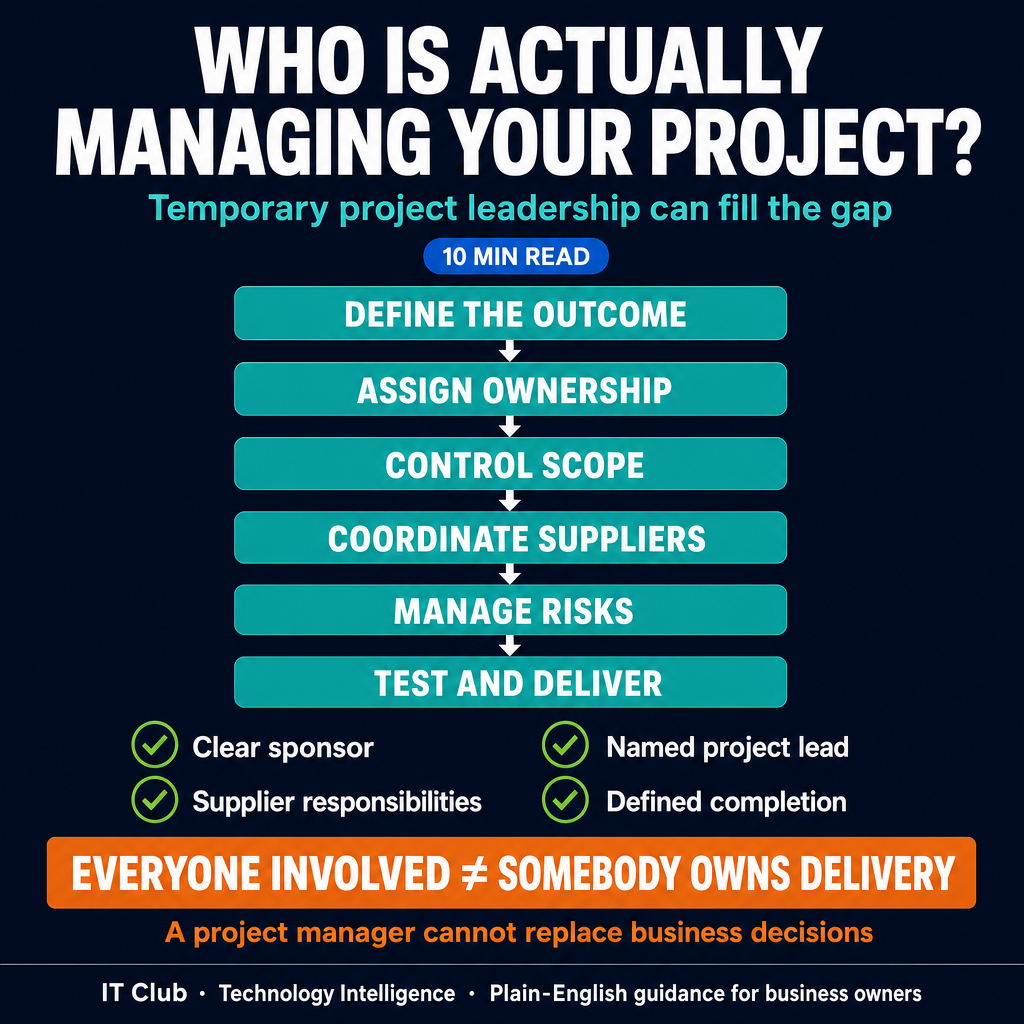
Tap to follow The IT Club Briefing on WhatsApp.
Related Articles
Is Your Website Actually Backed Up? Why a Cloud Website Still Needs a Recovery Plan
A website being hosted in the cloud does not automatically mean your business has an independent backup or a tested recovery plan. Learn what a useful website backup should protect, how GitHub can help, and what recovery questions to answer.
Read articleMoving from Exchange Server to Microsoft 365: What Businesses Need to Plan
Moving from Exchange Server to Microsoft 365 involves far more than copying mailboxes. Active Directory, shared mailboxes, public folders, applications, SMTP relays, DNS, security, devices, backup and the controlled retirement of Exchange itself all require deliberate planning. Microsoft supports several migration routes, but the correct method depends on the source environment — and the old server may retain a management role long after the last mailbox has moved.
Read articleMoving Between Microsoft 365 Tenants: What Businesses Need to Plan
When a business acquires another company and both already use Microsoft 365, the assumption is that consolidation should be straightforward. It is not. A Microsoft 365 tenant-to-tenant migration must address identities, domains, email, OneDrive, SharePoint, Teams, applications, devices, security and compliance — each as a separate workload. Microsoft now provides more native migration capability than it did several years ago, but no single tool automatically moves every setting, permission and dependency.
Read article