
When a website works everywhere except inside your own office, the natural instinct is to blame someone. The problem is there are three plausible culprits — the DNS, the network path and the web server itself — and each supplier instinctively looks at their own system, finds it working, and points elsewhere. This article explains the diagnostic method that cuts through the blame cycle and identifies where the fault actually sits.
Quick Answer
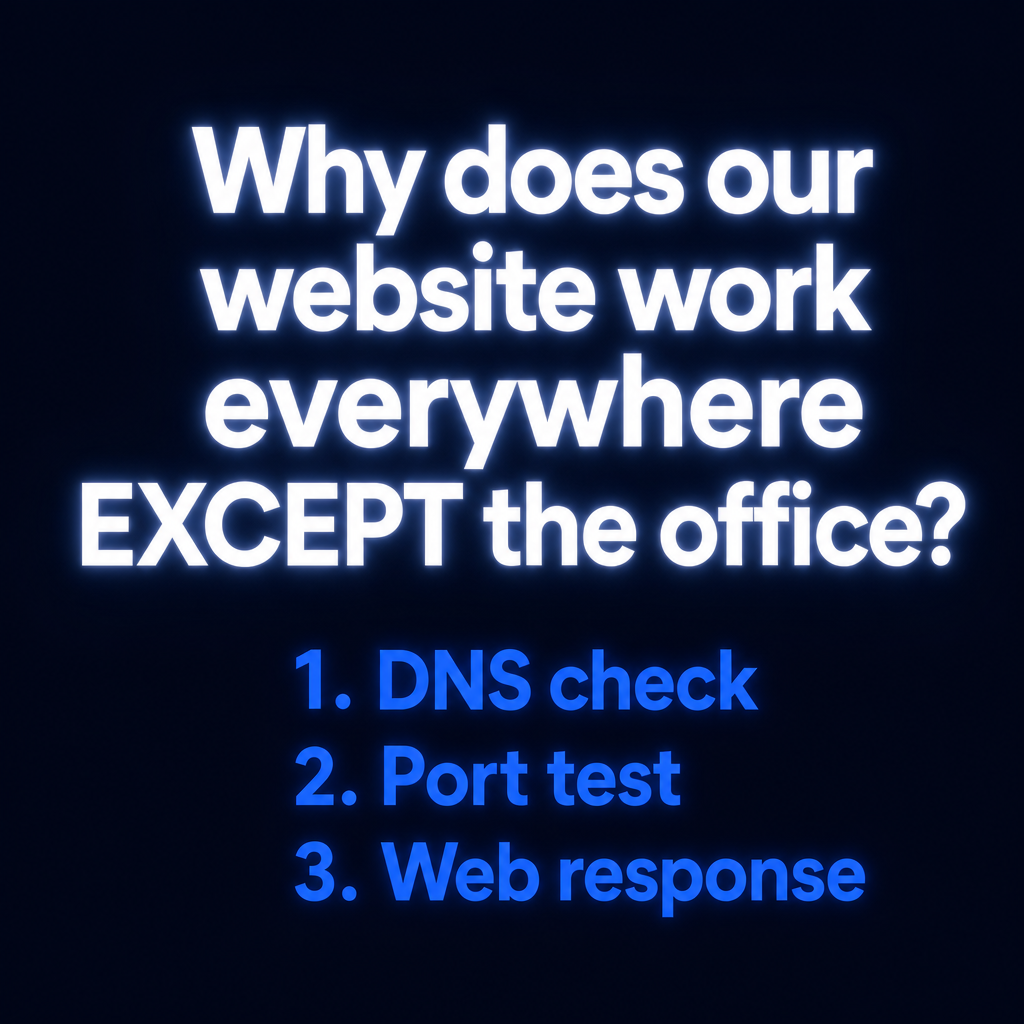
Test three things separately: whether the domain resolves to the correct IP address (DNS), whether a connection to the server on port 443 actually completes (network path), and whether the server returns the website normally (web response). Do this from both the affected office and an external connection. The comparison tells you precisely which layer has failed and which supplier is responsible.
This question has been published anonymously. Details that could identify the person or organisation have been removed.
Why This Type of Fault Produces a Three-Way Blame Cycle
A website that works externally but not from a specific office involves at least three separate systems: the DNS infrastructure, the network path between the office and the server, and the web server itself. Each supplier looks at the part they are responsible for, finds it functioning, and reasonably concludes the problem must sit somewhere else.
The telecoms provider checks that the office has an internet connection — and it does. The web developer checks that the website loads from their location — and it does. The IT company checks the office network internally — and finds nothing obviously broken. All three assessments are individually correct. None of them proves what actually happens on the path between the office and the website.
This is why the symptom — 'the website doesn't work' — is not enough information to resolve the problem. It needs to be broken into testable components.
The Three Things to Test Separately
A working website connection requires three things to function correctly in sequence. Testing each one independently tells you which layer is broken.
Layer 1: DNS — Does the domain resolve to the correct IP address?
DNS translates a domain name — such as example.com — into the IP address of the server hosting the website. If DNS is broken, the browser cannot find the server at all and will typically show a 'DNS_PROBE_FINISHED_NXDOMAIN' or 'server not found' error rather than 'site can't be reached'.
Testing DNS from two locations is simple. On Windows, open a command prompt and type: nslookup yourdomain.com. On macOS or Linux: dig yourdomain.com. If both locations return the same IP address, DNS is working correctly on both. If the results differ, or one location cannot resolve the name at all, the DNS configuration is the fault.
Layer 2: Network path — Can the office reach the server on port 443?
A browser accessing a website over HTTPS connects to the server on TCP port 443. If the DNS resolves correctly but the connection times out or is refused, something on the network path is blocking it. That could be a firewall rule at the office, a rule at the telecoms provider, or a block further up the network.
The test is: can the office establish a TCP connection to the server on port 443? This can be tested with: Test-NetConnection yourdomain.com -Port 443 (PowerShell on Windows) or nc -vz yourdomain.com 443 (macOS/Linux). A timeout or connection refused result from the office, when the same test succeeds from outside the office, isolates the fault to the network path.
Critically: test this using both the domain name and the server's raw IP address. If both fail, DNS is ruled out as the cause. The connection is being blocked regardless of how the server is addressed.
Layer 3: Web response — Does the server return the website?
Once a TCP connection succeeds, the server should respond with HTTP headers and page content. If the connection completes but the server returns an error, the fault is in the web server configuration or hosting — not the network. A tool like curl -I https://yourdomain.com will show the HTTP status code and headers returned by the server.
If this test works from an external connection but not from the office, and the TCP connection itself times out from the office, you already know the fault is in layer 2 — the network path. You do not need to reach layer 3.
What the Tests Showed in This Case
Working through the three-layer test from both the affected office and a separate external connection produced the following results.
| Test | External connection | Office connection |
|---|---|---|
| DNS resolution (nslookup) | Resolved to correct IP address | Resolved to same IP address |
| TCP connection to port 443 (domain name) | Connected successfully | Timed out |
| TCP connection to port 443 (raw IP address) | Connected successfully | Timed out |
| Web server response (curl) | HTTP 200 — website returned normally | Not reached |
The DNS test produced identical results from both locations. That ruled out a split-DNS problem and any DNS-related cause entirely.
The TCP connection tests told the real story. Port 443 was unreachable from the office, and the result was the same whether tested by domain name or raw IP address. This meant the block was not DNS-related — something was actively preventing the TCP connection from completing, regardless of how the server was addressed.
That combination of results could only be explained by something between the office and the web server — a firewall, a content filter, or a routing policy — blocking outbound connections to that specific IP address or port.
With that evidence in hand, the telecoms provider was given something specific to investigate: a firewall rule affecting outbound TCP connections to this destination. The block was traced to a misconfigured firewall rule on the telecoms side. Once corrected, the website became accessible from the office.
Common Causes of This Type of Fault
A website that is unreachable from one office only, while working everywhere else, usually has one of these underlying causes.
- A firewall rule at the office perimeter or within the telecoms provider's network blocking outbound connections to specific IP addresses, ports or domains — sometimes introduced by a policy change or equipment update
- Content filtering software configured to block a category that has incorrectly classified the website — IT security tools that filter web traffic can block sites based on category, reputation score or domain age
- A web application firewall on the hosting side that has geo-blocked or rate-limited the office's public IP address — sometimes triggered by scanning activity from that IP
- A routing or BGP change that has redirected traffic from the office through a different path where a block exists
- CGNAT (Carrier-Grade NAT) situations where the office shares a public IP with many other customers, and one of those customers has caused the IP to be blocked by a security service
- Split-DNS misconfiguration that causes internal users to resolve the domain to a different address from external users — typically an internal server that is not running the website
In this case the fault was a telecoms firewall rule. The TCP test from both domain name and raw IP address was the key — it proved the block existed independently of DNS, which directed attention to the right place.
How to Give Suppliers Something Concrete to Investigate
The problem with 'the website doesn't work' as a support ticket is that every supplier can correctly demonstrate their own system is functioning and hand it on. Evidence replaces that dynamic.
In this case the evidence was: DNS resolves correctly from both locations to the same IP address. Port 443 connection times out from the office, tested against both the domain name and the raw IP address. The same test succeeds from an external connection. This means the fault lies in the network path between the office and the server.
That statement cannot be argued with by either the web developer (their server is reachable externally) or the IT company (their internal network is fine — the block is further out). It directs responsibility to the only remaining candidate: the network path, which is the telecoms provider's domain.
When testing from the office, note your public IP address (search 'what is my IP' from the affected connection). This is useful to provide to the telecoms provider and to the web host — both may need it to investigate firewall logs or access rules.
A Practical Sequence for Diagnosing Office Connectivity Problems
- 1Confirm the symptom is consistent — test from multiple devices on the same office network and from a mobile device on the office Wi-Fi versus mobile data. This confirms it is the network, not a single device.
- 2Note the exact error message — 'ERR_CONNECTION_TIMED_OUT' and 'ERR_NAME_NOT_RESOLVED' point to different layers. Timed out means the connection is not reaching the server. Name not resolved means DNS failed first.
- 3Run the DNS test from inside and outside the office — confirm whether both return the same IP address.
- 4Run the TCP port test from inside and outside — test against port 443 using both domain name and raw IP address.
- 5If the port test fails from inside the office, note your public IP address and contact the telecoms provider with specific evidence of where the block occurs.
- 6If the port test succeeds but the website still does not load, the fault is in the web server or hosting — contact the web developer with the HTTP response or error returned by curl.
Is Your Office Network Blocking Something It Shouldn't?
If you are experiencing connectivity problems and not getting clear answers from your suppliers, Ask the Advisor. Describe the symptom and what tests have been run, and IT Club can help you identify which layer the fault sits in and what evidence to provide to get it resolved.
IT Club View
The three-layer diagnostic approach — DNS, connectivity, web response — works for almost any 'website doesn't work from here' problem. It is not technically complex; the tools are available on any business computer. The value is not in the tools themselves but in the discipline of testing each layer separately and comparing results from two different connections.
When all three suppliers are confident the problem is not theirs, it usually means none of them has tested the full path. Two targeted tests from the office — DNS resolution and a TCP connection to port 443 — produce evidence that cannot be argued with. They turn a vague multi-supplier dispute into a one-line instruction to the correct party.
It is also worth noting what the tests ruled out quickly. DNS was confirmed correct within seconds. The web server was confirmed working from outside. That left only one explanation: something between the office and the server was blocking the connection. The rest of the investigation was a matter of working with the telecoms provider to find it.
Related Business Questions
How do I tell if a connectivity problem is on my office side or the supplier's side?
Test the same destination from two different internet connections — one from the affected office and one from a completely separate connection such as a mobile hotspot or a different office. If the destination is reachable from one and not the other, the problem is in the network of the connection that fails. This comparison is the most important diagnostic step.
What does a TCP connection timeout actually mean?
A TCP timeout means that the device attempting the connection sent a request to the server and received no response within the timeout period. Unlike a refused connection (which is an active rejection), a timeout usually means the connection was silently dropped — typically by a firewall — before it reached the server. The device kept waiting for a response that never came.
Why does testing with the raw IP address matter?
Testing the TCP connection using the server's raw IP address rather than the domain name eliminates DNS from the picture. If the connection times out using the domain name but succeeds using the IP, DNS is the cause. If both fail identically, DNS is not involved — the block applies to the IP address itself. In this case both failed, which confirmed the block had nothing to do with how the server was named.
Can a web host block my office by mistake?
Yes. Web application firewalls and hosting security services sometimes block IP addresses that have been associated with scanning activity, repeated authentication failures or other automated behaviour. If the office's public IP address has been used by a previous occupant, or is shared with many other customers through a provider using CGNAT, it may have accumulated a poor reputation. Providing your public IP address to your web host allows them to check whether it appears in any block lists.
Should this type of test be part of our IT support contract?
Basic connectivity diagnostics should be within scope for any IT support provider managing a business network. The challenge arises when the fault crosses the boundary between managed IT support and the telecoms connection — different providers, different contracts, different accountability. Ensuring your IT support contract specifies what happens in that scenario — who coordinates between suppliers, who owns the diagnostic process — saves significant time when an incident occurs.
What Your IT Provider Should Monitor →
Business Broadband Contracts: What Should You Check Before Signing? →
Choosing an IT Support Company in Manchester: A Buyer’s Guide →
Choosing an IT Support Company in Bristol: A Buyer’s Guide →
Choosing an IT Support Company in London: A Buyer’s Guide →
Choosing an IT Support Company in Leeds: A Buyer’s Guide →
Choosing an IT Support Company in Birmingham: A Buyer’s Guide →
Plain-English Takeaway
When a website is unreachable from one location only, the fault almost always lies in the network path between that office and the server. Test DNS resolution, TCP connectivity and the web response as three separate checks. The results tell you which layer has failed and which supplier owns it — replacing guesswork with evidence.
Tap to follow The IT Club Briefing on WhatsApp.
Related Articles
Do I Really Need to Spend £1,000+ on a Business Laptop?
Need a powerful business laptop without spending £1,000+? See why a refurbished workstation with 32 GB RAM can offer better value for many SMEs.
Read articleA Customer Has Asked for All Their Data — What Do You Do?
A customer asks what personal data you hold, says they never agreed to marketing and wants everything deleted. This practical UK guide explains what a small business should do first — without treating one email as one simple request.
Read articleDoes MFA Have to Apply to Every Microsoft 365 Guest?
Does every Microsoft 365 guest need MFA? IT Club explains Teams meetings, SharePoint sharing, guest access and Conditional Access in plain English.
Read article